What are the conditions of modest dress for women in Islam?
The short answer
Scholars describe a Muslim woman’s dress in front of unrelated men through conditions drawn from the Qur’an and Sunnah: it covers the body, is loose enough not to show the figure, is thick enough not to be see-through, is not itself an eye-catching adornment, and does not imitate men’s clothing. These conditions belong to no single culture.
What does the Qur’an say?
The two key texts are in Surat An-Nur and Surat Al-Ahzab. The first tells women not to display their adornment except what ordinarily appears and to draw their head-covers over their chests; the second tells them to draw their outer garments over themselves. Translation of meaning:
“…and not expose their adornment except that which [necessarily] appears thereof and to wrap [a portion of] their headcovers over their chests…”
“O Prophet, tell your wives and your daughters and the women of the believers to bring down over themselves [part] of their outer garments…”
The conditions scholars list
From these texts and the Sunnah, works of jurisprudence and fatwa repeat the same criteria for clothing worn in front of men who are not mahram:
- It covers the body. Jurists differ on the face and hands; the majority, including the Maliki school, hold that they are not ‘awrah.
- It is loose and does not show the shape of the body.
- It is thick and not see-through.
- It is not itself an adornment that draws attention.
- It does not imitate men’s clothing.
No required colour or costume
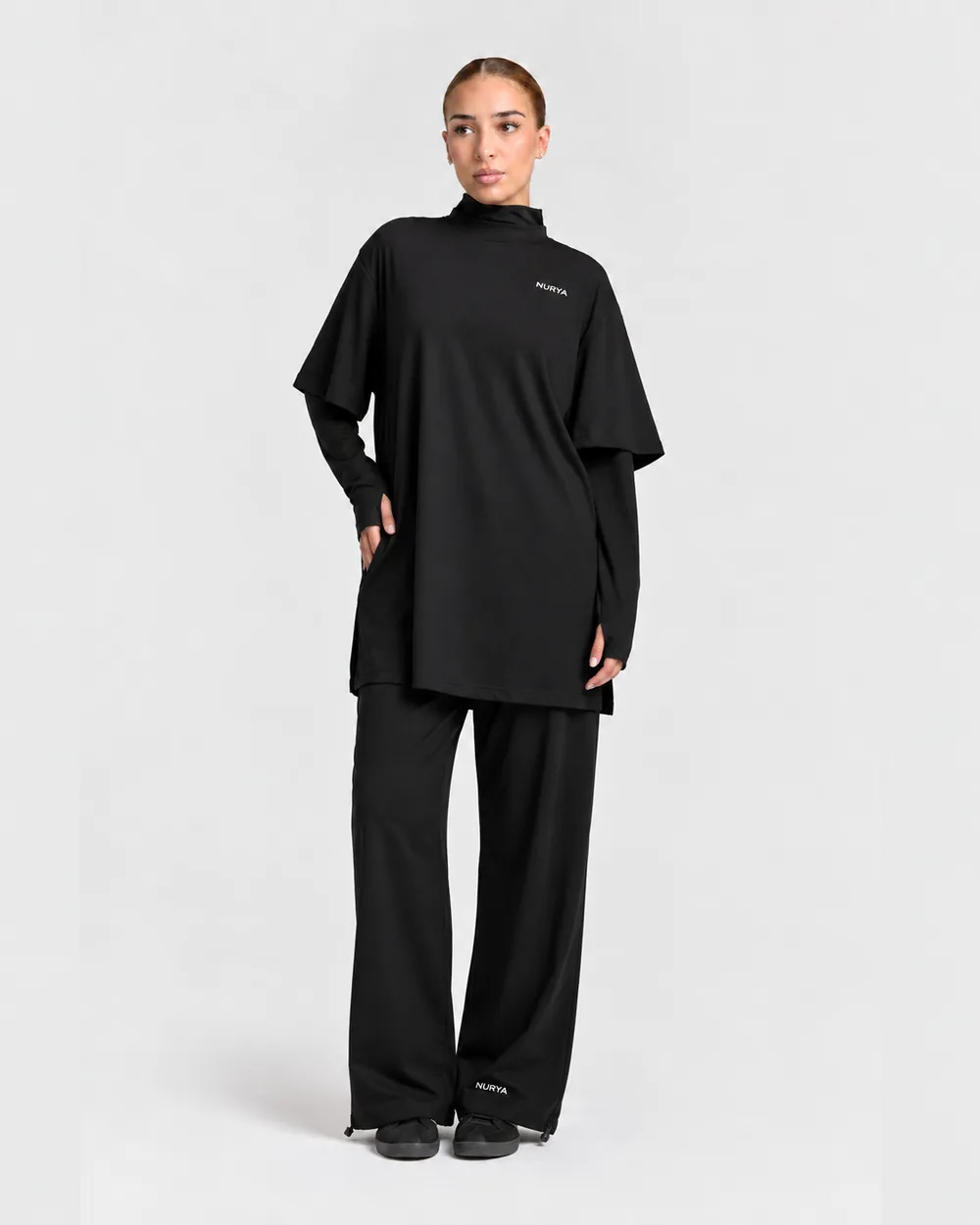
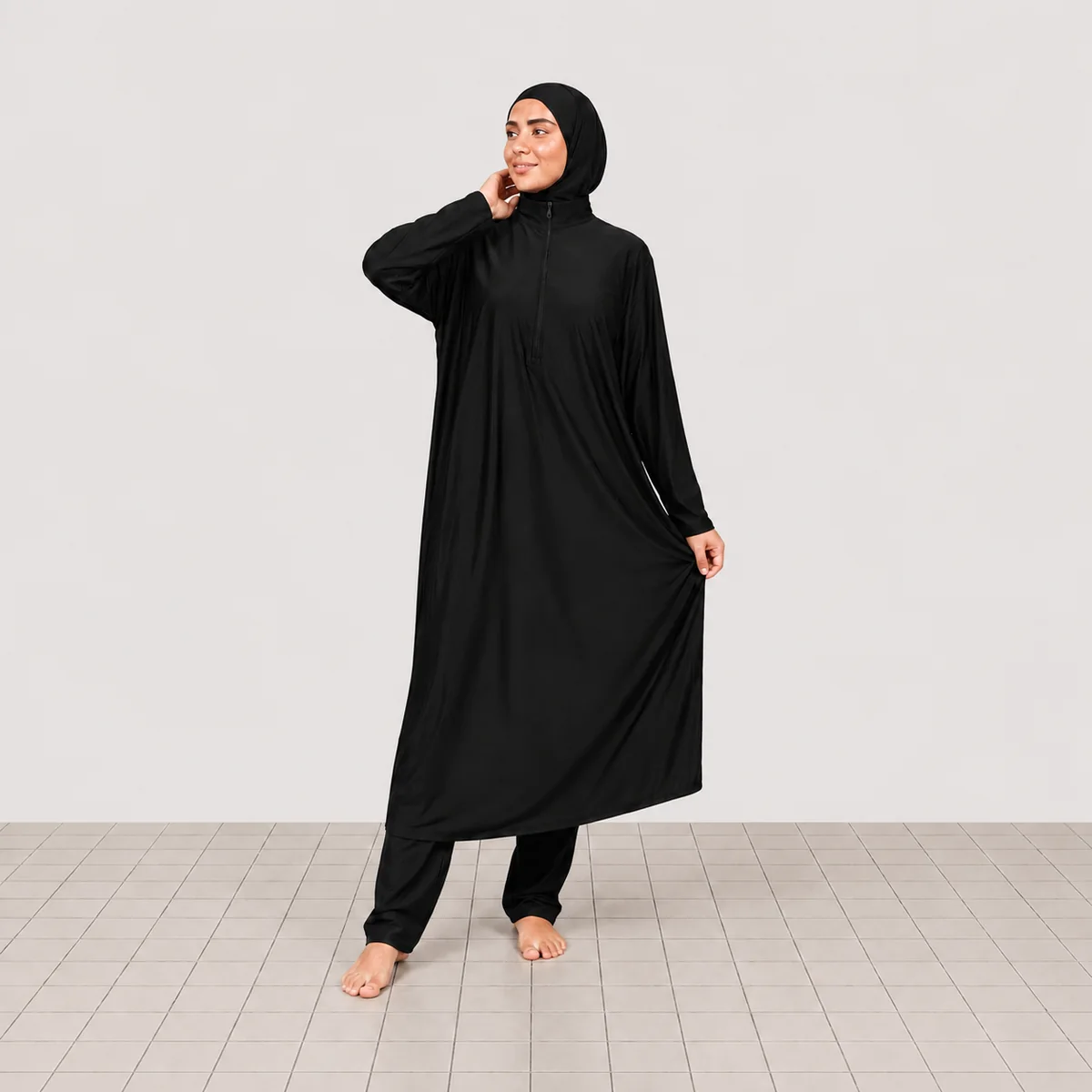
Scholars stress that these conditions are general and not tied to any one society: any outfit that meets them is acceptable, whether an abaya or a long tunic over wide trousers. The texts set no colour; what matters is that the clothing is not an eye-catching adornment in itself, which is judged by local custom.
How do you apply them in practice?
The criteria are clear; the hard part is usually finding the right piece. Four checks before you buy:
- Length: does the top cover your hips, even when you sit or raise your arms?
- Fit: does the cut stay relaxed when you move, or does it cling?
- Opacity: in strong light, can skin be seen through the fabric?
- Wet test: does the fabric cling when it gets wet? This matters for sport and swimming.
What about sport and swimming?
The same conditions apply to sportswear and swimwear: a loose piece that does not cling with sweat or water, in an opaque fabric. Questions about swimming venues and mixed settings are discussed in detail by scholars; it is best to ask a person of knowledge.
Who can you ask a personal question?
Morocco follows the Maliki school. Its official fatwa body is the committee in charge of fatwas of the Supreme Council of Ulema, and the local councils of ulema take questions in every province.
Frequently asked questions
Does modest dress have to be black?
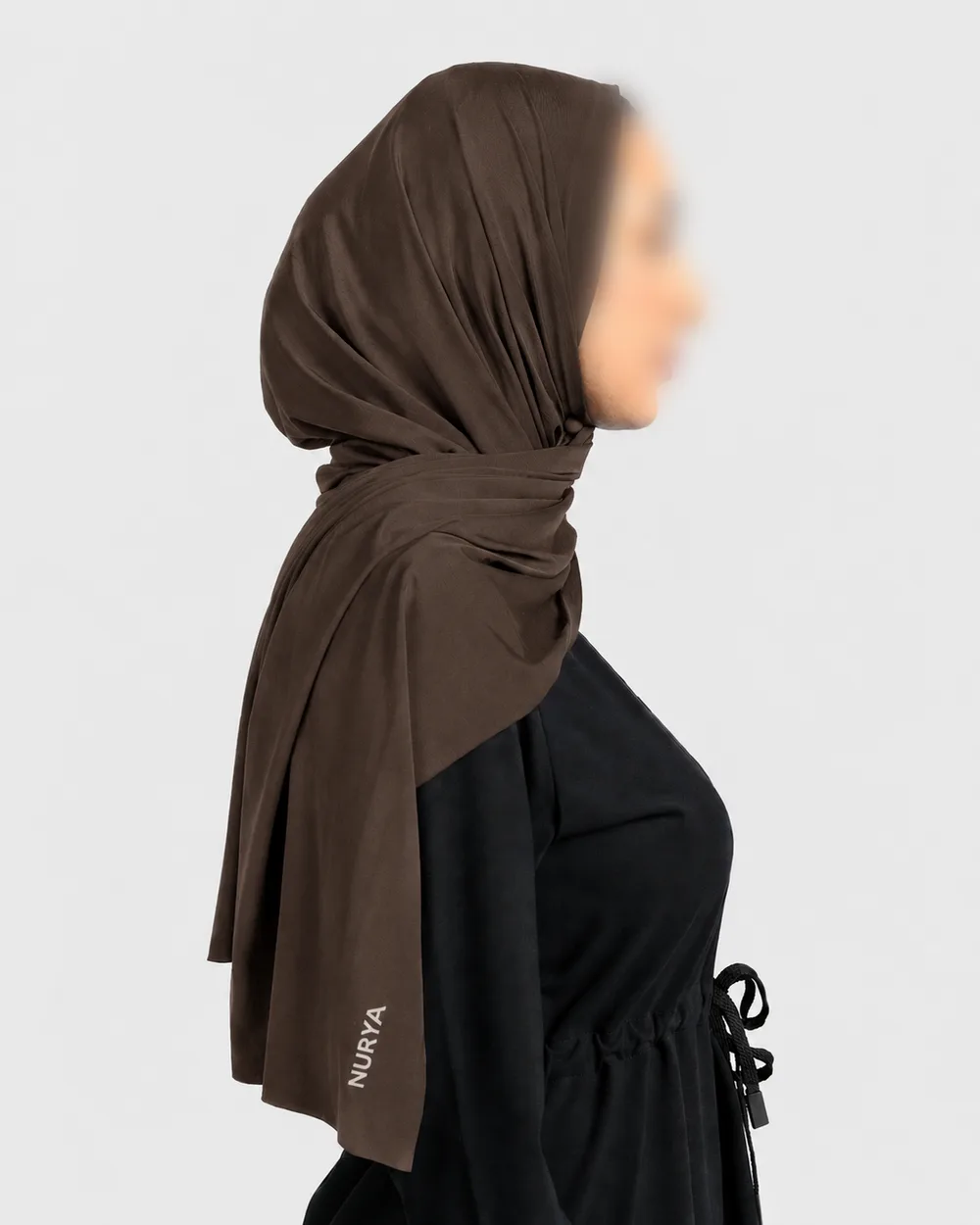
No. The texts set no colour; the condition is that the clothing is not itself an adornment that draws attention.
Is Islamic dress tied to one culture?
No. Scholars state that its conditions are general: any covering, loose and opaque outfit qualifies, whatever its style.
Are the face and hands part of the ‘awrah?
It is a matter of scholarly difference. The majority, including the Maliki school followed in Morocco, hold that they are not.
Sources
This article summarises what scholars report; it is not a fatwa. For a personal question, ask a person of knowledge.